Wisdom Wednesday
Wisdom Wednesday: The Underground CEO - Harriet Tubman's Strategy in the Shadows
Part 1 of 5 · Revolutionary Leadership Series
July 1, 2026

Part 1 of the Revolutionary Leadership Series - publishing each Wednesday in July 2026
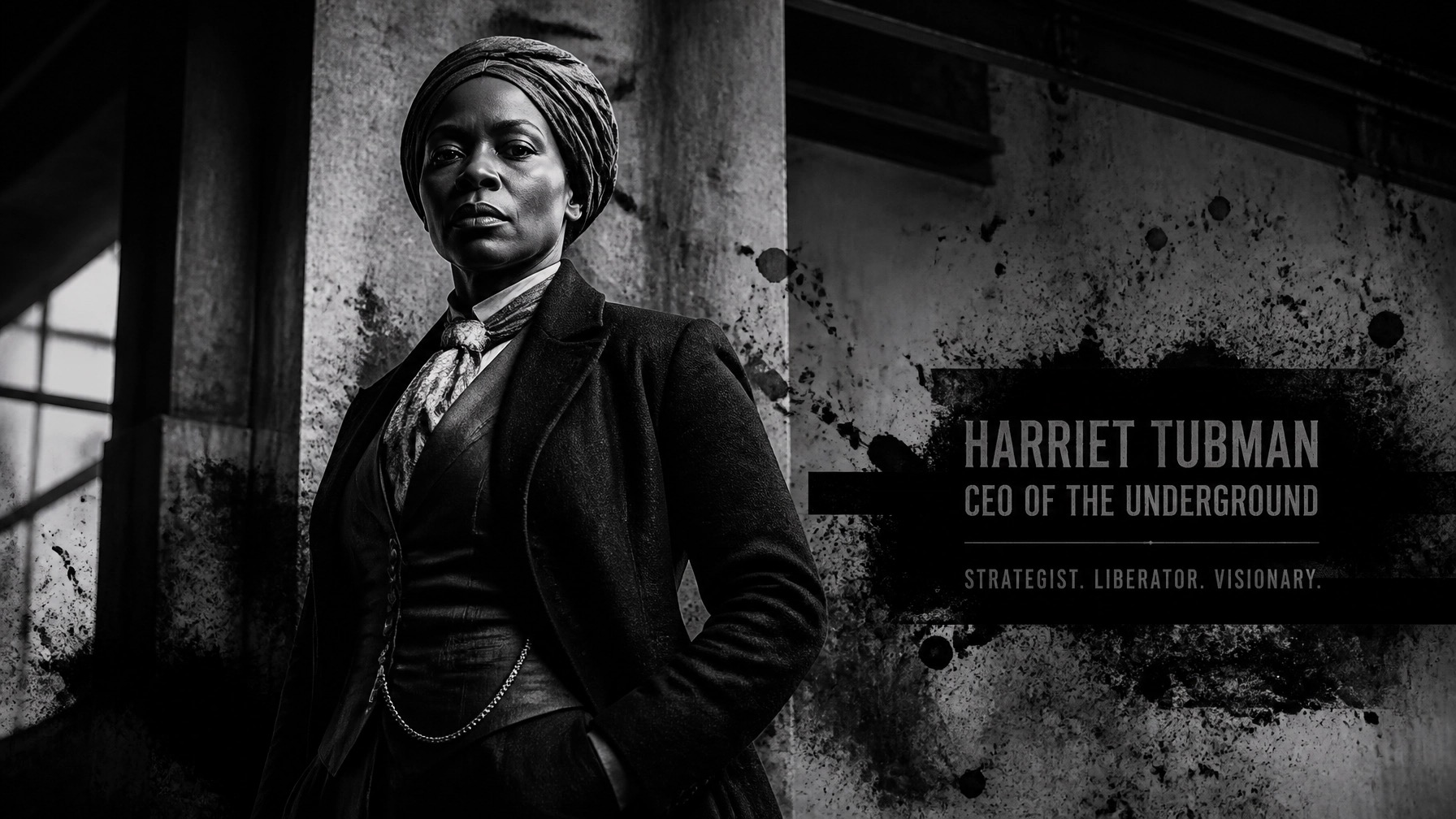
Harriet Tubman
History has a habit of declawing its geniuses.
The version of Harriet Tubman most of us were handed - a brave woman with a lantern, a symbol of quiet endurance - is a story laundered of its most dangerous element: her mind. Tubman wasn't running on courage alone. She was running on intelligence. She was a systems thinker operating inside a system designed to kill her, and she beat it thirteen times without losing a single person.
That's not inspiration. That's a masterclass.
As the United States crosses the threshold of its 250th year, most organizational leaders are managing drift - adjusting spreadsheets, softening messages, waiting for "stability" before making the next move. Tubman had no such luxury, and that constraint produced a kind of strategic clarity that most boardrooms will never touch. The question isn't whether her playbook applies to you. It's whether you're ready to use it.
The Saturday Night Pivot: Finding the Seam in the System
Most leaders treat constraints as obstacles. Tubman treated them as intelligence.
She noticed something the slaveholders never thought to protect: Sunday was the one day newspapers didn't print. That meant runaway notices couldn't run until Monday. By launching her escapes on Saturday nights, she built a 36-hour window - a hard lead that no patrol could easily close - before a single description of her passengers hit the press.
This wasn't instinct. It was analysis. She mapped the enemy's calendar, found the seam, and exploited it with precision. She understood the timing of the establishment better than the establishment understood itself.
At Visionary Consulting, we see this miscalculation constantly: leaders who know their industry deeply but haven't studied it like an adversary. They know their product. They don't know the gap. Tubman didn't wait for ideal conditions - she created them, using the terrain itself as cover. The stars became her navigation system. The swamps became her perimeter defense. The environment that was designed to trap her became her primary operational asset.
The question for you: Where is your Saturday night? What does your competitive landscape do on its day of rest — and are you mapping it?

A Map of The Underground Railroad
The Firearm and the Firewall: What Alignment Actually Costs
There's a comfortable myth in leadership culture that the best leaders bring everyone along. Tubman would have failed on that principle inside the first mile.
She carried a revolver. And it wasn't only for the hunters.
If a passenger lost their nerve and turned back, they risked collapsing the entire network under interrogation. So her terms were absolute: you keep moving, or you don't make it back at all. This wasn't brutality - it was the mathematics of survival at scale. One person's fear, unmanaged, could end freedom for everyone behind them.
We talk about alignment in organizations as though it's achieved through consensus and good vibes. Tubman's version of alignment had real stakes attached. She demanded a level of commitment that left no room for the slow erosion of maybe - that particular corporate killer that lets projects die by a thousand qualifications.
When you work with the team at Visionary Consulting, that's what we're building toward. Not comfort. Not consensus theater. The kind of conviction that holds when the mission gets hard and the easiest option is the exit door.
The question for you: Are you leading people through something, or are you managing people who are waiting for it to be over?

A doorway symbolizing a pivot to the plan
The Canada Pivot: When the Map Catches Fire
In 1850, the Fugitive Slave Act didn't just raise the stakes - it relocated them. Suddenly, reaching Philadelphia or New York wasn't freedom. The entire Northern United States had become hostile territory, with legal obligations to return escaped people to bondage. The goalposts hadn't moved. They'd been incinerated.
A reactive leader would have paused. Tubman pivoted.
She rerouted her entire operation to St. Catharines, Ontario - not a detour, but a complete architectural rebuild of her network. New contacts. New routes. New risk calculus. International scope, from a woman who had taught herself to navigate by stars and read landscapes in the dark.
This is the move that separates adaptable leaders from truly disruptive ones. The adaptable leader adjusts to a new environment. The disruptive leader tears up the old map entirely and draws one that goes somewhere the enemy hasn't considered yet.
We are living through that kind of moment right now - in AI, in organizational design, in the nature of work itself. The leaders who are clinging to the frameworks that worked in 2019 are doing the equivalent of running freedom routes through Philadelphia after the Act passed. The destination changed. The strategy has to follow.
The question for you: Are you adapting to the new landscape, or still optimizing for the old one?

A leader upping the ante.
The Combahee River Raid: Scaling Without Losing Yourself
The Underground Railroad made Tubman a legend. The Combahee River Raid made her an executive.
In June 1863, she became the first woman in American history to lead an armed military assault. But she didn't walk into it on reputation. She spent months building a network of local informants - freedom seekers and Black community members who knew exactly where Confederate forces had placed mines in the river's channel. She converted that human intelligence into a precision operational map, then used it to guide three Union gunboats through what Confederate forces believed was impenetrable territory.
In a single night, more than 700 people were liberated.
The strategic leap here matters: she didn't change who she was to operate at that scale. She didn't become a different kind of leader. She took the same forensic intelligence model she'd used in the forest - study the system, find the gap, move with precision and speed - and applied it at the level of a military campaign. The skills were identical. The thermal intensity was higher. The outcome was historic.
This is what scaling actually looks like. Not adding headcount or expanding the org chart. Applying the same core methodology to a larger, more complex problem - and trusting that the methodology is sound enough to hold.
The question for you: What is your core methodology? And have you tested it at a scale that scares you?

Visionary Consulting breaking through the noise.
Unearthing Your Revolutionary Edge
We are at the 250th year of an American experiment that has always been contested, always been unfinished, and right now feels like it's calling for something more than incremental improvement.
This is not the moment for safe plays.
History doesn't remember the leaders who managed the status quo carefully. It remembers the ones who read the terrain clearly enough to know when the map had to burn, who built something in the dark that daylight couldn't destroy, and who held their people to a standard of conviction that turned fear into forward motion.
Tubman never lost a passenger. Not because she was lucky. Because she was relentless in her preparation, ruthless in her risk management, and completely clear about where she was going and why it mattered.
At Visionary Consulting, we specialize in exactly that kind of clarity - for executives, for teams, for organizations that know something has to change but haven't yet found the edge from which to change it. Whether you're seeking a career consultation to redefine your trajectory, or looking to overhaul your organization's strategic DNA, the work starts with one question:
Do you have the conviction of the Underground CEO?
The revolution doesn't wait for permission. It's time to stop managing the erosion and start the disruption.
This is Part 1 of the Revolutionary Leadership Series. Next: Joan of Arc — The Cost of Conviction, When the Vision Is a Fire.
Wisdom Wednesday: The Manager You Automated Was Never the Manager You Needed
Wisdom Wednesday - Go Be Pretty: Hedy Lamarr and the Invention They Refused to Credit
The Revolutionary Leadership Series
Five leaders, five eras, one question: what does revolutionary leadership actually cost?
- 01Wisdom Wednesday: The Underground CEO - Harriet Tubman's Strategy in the Shadows (you are here)
- 02Wisdom Wednesday: The Cost of Conviction: Joan of Arc - When the Vision is a Fire
- 03Wisdom Wednesday: The Quiet Coup: MacKenzie Scott and the Destruction of the Fortress
- 04Wisdom Wednesday: The Art of the Long Game: What Stephen Sondheim Knew About Building What the Market Doesn't Know It Wants Yet
- 05Wisdom Wednesday - Go Be Pretty: Hedy Lamarr and the Invention They Refused to Credit
Ready to talk it through?
Book a free consultation (30 min) →