Honoring Black History Month: SHE IS BLACK
February 11, 2026

Highlighting my dear friend, Allan Dombroski and his perspective, I am inviting you to read his amazing insights from an excerpt of his upcoming book The Singularity of the Soul. He is my first guest author for "Wisdom Wednesday". Enjoy!
SHE IS BLACK
It took me thirty years to understand just how luminous the dark can be.
Not the darkness that swallows enthusiasm or joy—not despair dressed up as depth—but the darkness that stills you long enough to hear what the noise has been covering: the quiet insistence beneath ambition and performance that has been waiting, patiently, to be acknowledged.
Alan Watts helped me find my way back to that ground.
You don’t need his full biography. It’s enough to know he was among the first Western voices willing to translate Eastern cosmologies without shrinking them into inherited doctrine—willing to suggest that our image of God might be cultural before it is ultimate.
In one lecture—sermon, perhaps; meditation disguised as philosophy—he recounts a story about an astronaut returning from space. The astronaut is asked whether he had been to heaven, whether he had seen God.
“Yes,” he answers.
And Watts delivers the line:
She is black.
There’s a murmur. A ripple of laughter. Watts waits. The silence stretches longer than the laugh expects it to.
That pause matters because the laughter is reflex: the nervous repair of a worldview just destabilized. Something sacred refused its assigned costume, and the room rushed to make it small again. Watts doesn’t rescue them from the discomfort. He lets the opening remain an opening.
Because the line doesn’t merely swap pronouns. It exposes what we were trained to assume without noticing: that ultimacy must be masculine, luminous, crowned—a face that commands, a voice that legislates, a light that proves itself by being seen.
So when the astronaut says She, something flinches.
And when he says black, something older than theology stirs.
Watts isn’t replacing one idol with another. He’s exposing how idols get installed—how an image hardens into metaphysics, and metaphysics hardens into culture, until inheritance starts masquerading as truth.
She is black.
Not black as negation. Black as condition. The depth against which light becomes visible. The ground that allows form to appear without demanding obedience in return.
Without that blackness, light has nowhere to shine.
Without that ground, nothing holds.
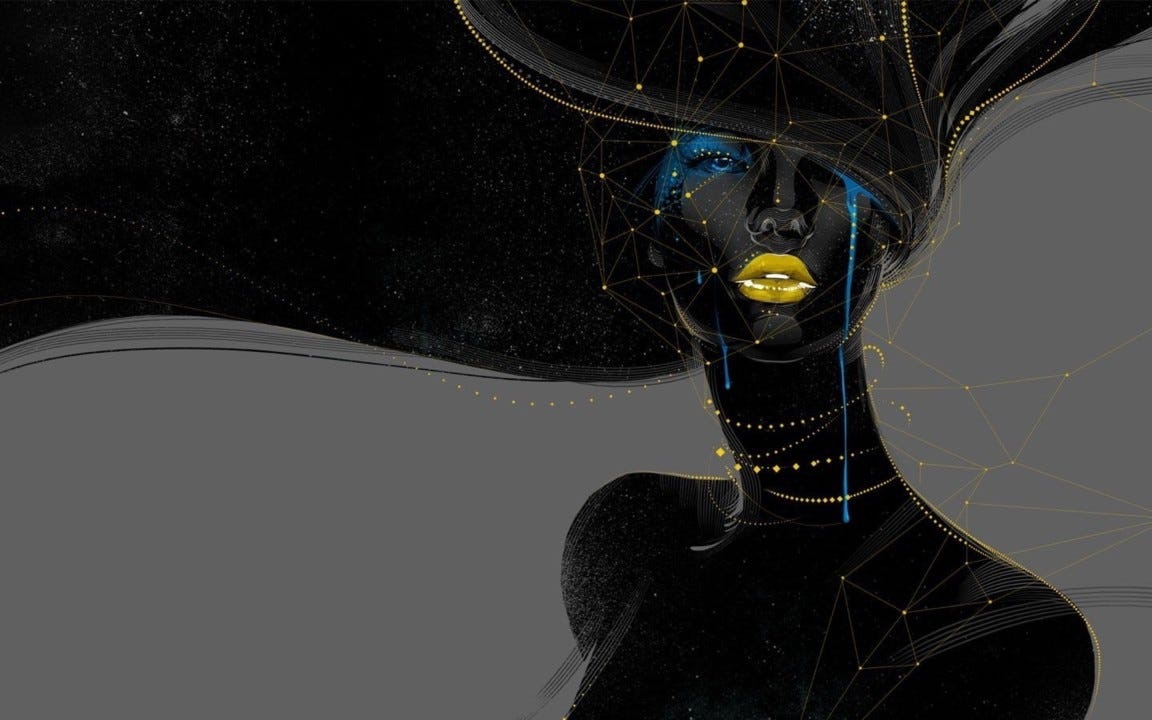
THE INHERITED IMAGE
Worldviews stop feeling like choices once they’ve been inherited long enough; they start passing as common sense—not because they’re inevitable, but because they’re everywhere.
The paternal image of God—authoritative, above—didn’t stay in churches. It trained a reflex: order as vertical, authority as command, legitimacy as something that descends. Reinforced by institution and consensus, repeated until the analogy becomes the only one available, it turns into posture: what we call strength, what we call leadership, what we call reality.
Watts names the trap with blunt clarity: it’s all prepared for you—packaged, institutionalized, waiting. Under social consensus, it becomes natural to assume that when someone says “God,” they mean the father figure, because even Jesus, in his culture, had no other image available.
That’s how an image becomes infrastructure.
Light gets coded as purity. Dark gets coded as danger. Spirit becomes superior. Matter becomes lesser. Control becomes strength. Receptivity becomes weakness. You can stop believing the doctrine and still keep the posture; you can reject the church and still live inside the architecture the church trained into the culture.
Once that architecture starts reading as “the way things are,” hierarchy doesn’t look designed.
It looks like the world.
THE GROUND THEY EDITED OUT
Every regime of domination has requirements: extraction, subjugation, misaligned truth, and the convenient amnesia of history—because a system that remembers what it did cannot keep calling itself legitimate.
She is black is not Watts “reaching,” and it isn’t a mistake. It is a crack in the inherited image—a refusal of the old costume. The room’s laughter doesn’t prove the line was wrong. It proves the spell was working. It proves how quickly inherited power tries to turn disruption into a joke so nobody has to feel what just shifted.
Blackness here is not metaphor, not symbol, not aesthetic. It is placement. It names what power did, and who it forced underneath so “order” could be built and blessed.
The modern world was not built only with ideas; it was built with theft—of land, of labor, of breath. Enslavement, extraction, enclosure, colonization: not deviations from the system, but the means by which the system was produced and stabilized.
Black bodies were rendered into capital. Black land into resource. Black culture into commodity. Black suffering into background noise.
All of it underwritten by a sanctified hierarchy aligned so cleanly it could pass for nature:
God above man.
Man above woman.
Human above Earth.
White above Black.
Owner above owned.
Order above life.
This is the monarchy image poured into law, economy, and common sense.
The ground was never passive. It was made to carry without being named. And when the record is managed—when history is diluted, softened, redacted—power gets to float above consequence. It gets insulated from the costs that keep it standing. It gets to keep calling itself reasonable.
THE INVERSION
Domination maintains itself by flipping the moral math.
It harms, then rebrands the response as the problem. It takes consequence and calls it chaos. It takes memory and calls it fixation. It takes plain speech and calls it division. This is not misunderstanding. It is maintenance. If the people bearing the cost are believed, the story that justifies the cost collapses.
When the ground cracks under pressure, it is called unstable. When it refuses, it is called dangerous. When it remembers, it is called stuck in the past. When it names what happened, it is called divisive. History is policed—curriculum, headlines, archives, the allowable vocabulary—because once the record becomes common knowledge, innocence becomes harder to perform.
Black life has been forced to carry contradiction without relief: sustaining systems that exclude it, demonstrating humanity to those who profit from denying it, staying composed while naming violence, being praised for resilience inside conditions designed to exhaust.
That proximity to consequence produces accuracy. It’s why some of the clearest diagnoses of American unreality have come from Black thinkers, Black artists, Black theologians, Black organizers—not from moral superiority, but from placement. The ground cannot afford illusion.
But accuracy without protection becomes attrition. If the truth costs you safety, livelihood, breath, people learn to swallow it—and then get blamed for choking. And the system does not “misread” that pressure as rage. It provokes the rage, then uses it as cover to tighten control. Raise the cost of speaking high enough, and silence starts getting treated as consent.
REFUSAL AS FIDELITY
There comes a point when continued participation becomes impossible—not as drama or heroism, but as fatigue: the weariness of translating reality into language that makes unreality easier to tolerate.
Refusal often arrives quietly, as grief, as the simple unwillingness to keep laundering distortion into politeness.
It gets mislabeled nihilism or separatism. It is closer to fidelity: fidelity to memory, to experience, to knowledge learned at cost. In Black life, refusal has rarely been theoretical. It has taken the form of survival technologies: mutual aid, sanctuary, parallel institutions, music that preserved breath, language that told the truth sideways when the straight line was lethal.
Not aesthetic gestures—technologies.
Slowness in a world that weaponizes speed. Memory in a culture addicted to forgetting. Care where extraction is normalized. Truth spoken without asking permission. These are coherence practices: ways of remaining whole inside systems designed to fragment.
Refusal reintroduces consequence where abstraction has insulated power. It isn’t destruction for its own sake. It is reality returning pressure to the places that have been protected from it.
Repair costs because repair moves weight.
AFTER THE SPELL
Dismantling an image does not create chaos; it clears space for relationship.
Authority, stripped of mystification, becomes responsibility. Power, brought close, becomes accountable. Meaning stops being decreed and becomes something practiced together, with costs shared instead of outsourced.
This is not utopia. It is maturity.
And it is also the point where we stop pretending information is the problem. The United States doesn’t suffer from a lack of facts; it suffers from trained forgetting—curated amnesia protected by shame, convenience, and the fear of what becomes required once the story is told without varnish.
Black History Month, at its deepest, is interruption: a refusal to let the ground be edited out again. A reminder that history is not past, that the order we were taught to revere was built on theft, and that the present still runs on momentum that has never been repaid.
Notice who still holds without being held. Who still pays first. Who still absorbs shock while the structure above calls itself stable.
The ground is not dark because it is empty.
It is dark because it is full.
GRATITUDE AS A MECHANISM
A system that stands on someone else will eventually ask that someone else to make the standing feel moral.
It rarely asks in the language of cruelty. It asks in softer demands that function the same way: patience as delay, explanation as unpaid labor, forgiveness as absolution without change, calm as the entry price of being heard.
Not because it’s confused about what it did.
Because it needs you to carry the story with the weight.
Gratitude becomes a lever—not gratitude as love, but gratitude as evidence. If the ground says thank you, the structure gets to call itself kind. If the ground stays composed, harm gets renamed misunderstanding. If the ground keeps teaching, the system gets to keep pretending it doesn’t already know.
Gratitude demanded is not virtue.
It is pressure wearing manners.
And when calm is required as the condition of being heard, it isn’t peace being requested.
It is permission to continue.
THE VIRTUE THEY INVENTED
The endurance of the marginalized gets repackaged as virtue so the architects of harm don’t have to face themselves.
They rename survival into something flattering—“work ethic,” “grit,” “resilience”—as if the ability to keep breathing under pressure is a personality trait instead of a sentence. Then they point to that survival as proof the conditions must be livable. That’s the trick: make people carry the weight, then use their carrying as evidence the weight is fair.
And the inversion lands right on schedule: if you are still here, it must not have been that bad.
Survival gets used as cover. Stability gets treated as innocence. Time becomes an accomplice—leave a wound untended long enough and people start calling the absence of consequence “closure,” as if neglect were proof that nothing is owed.
But survival isn’t absolution.
It’s testimony.
And testimony ignored long enough stops arriving as explanation. It arrives as boundary, as withdrawal, as the end of free access to the interior—not because the injured are cruel, but because they are tired of being recruited into the lie that nothing has to change.
THE RETURN
You do not get to keep borrowing against Black survival—not by demanding patience, not by weaponizing gratitude, not by asking for more time while the same bodies keep paying first.
You do not get to mistake endurance for consent.
You do not get to inherit a system built on imbalance and keep inheriting innocence, as though benefit comes without obligation. If something protects you, you are responsible for learning what it costs—and responsible for what becomes required once you know.
Repair begins when the weight moves—when what was taken is returned as return, and what is still being borne is redistributed as reality. That isn’t punishment. It’s the first honest description of the world.
Clarity eventually forces the deeper question: what kind of God ever sanctioned this in the first place? What kind of “order” needs theft to stabilize itself, needs amnesia to keep itself clean, needs the ground to stay quiet so the hierarchy can keep calling itself holy?
The answer is: an idol.
A crowned image mistaken for ultimacy.
And the work is to let the image collapse without panicking—to stop rebuilding domination in new language, to stop calling extraction “the way things are,” to stop treating the ground as disposable and then acting surprised when the ground remembers.
The dark that stills you is not empty. It is where performance falls away, where bargaining ends, where you can finally feel what has been there the whole time—without speeches, without permission, without a crown—simply holding.
She is black.
Not as a slogan.
As refusal: refusal to crown what should never have been crowned.
As return to the God behind our images of God—the one you cannot grasp, because grasping was always the symptom.
And when the grasping stops, something else becomes possible: not forgetting, not softness that asks the injured to carry more, not “moving on” as a euphemism for leaving things where they fell—but the kind of truth that can hold weight without lying about who has been bearing it.
Because the ground has been carrying long enough.
Ready to talk it through?
Book a free consultation (30 min) →