The Science of Being a Girl - Myths That Do Not Serve
February 25, 2026

The Early Messages
She is five when the first messages arrive.
Soft at first—pastel-colored gifts wrapped in glitter and ribbon. They come as dolls with perfect hair, tiny plastic kitchens, and dresses that sparkle more than the night sky she gazes at. Yet, no one notices her preference for the cardboard box, which she transforms into a rocket ship, counting down in whispers.
Learning the Basics
At school, she learns her letters:
- A is for apple.
- B is for butterfly.
- C is for cute.
When she finishes her math worksheet early, the teacher smiles politely, saying, “That’s nice,” before asking her to help pass out crayons. She does not yet know that praise and expectation are not the same.
Growing Awareness: Messages Intensify
By third grade, the messages grow louder.
Boys gather around the robotics kit while she watches from a distance, unsure if she is allowed to join. No one says she cannot, but the silence itself becomes instruction.
Classroom posters showcase astronauts and inventors, most looking nothing like her. When scientists are mentioned, they appear in textbooks with stern expressions and unfamiliar names. The lesson moves quickly, leaving little room for her to imagine herself among them.
Yet, she does imagine:
- Numbers as constellations.
- Equations as puzzles waiting for her hands.
Diverging Paths in Middle School
By middle school, the messages split into two directions.
One voice says: Be smart.
The other whispers: But not too smart.
Friends discuss outfits, popularity, and crushes. Store windows display mannequins instead of microscopes. Social media teaches angles and filters instead of curiosity. Amid algebra homework and hallway chatter, she begins to wonder if there’s space for both brilliance and belonging.
Still, she solves equations late into the night.
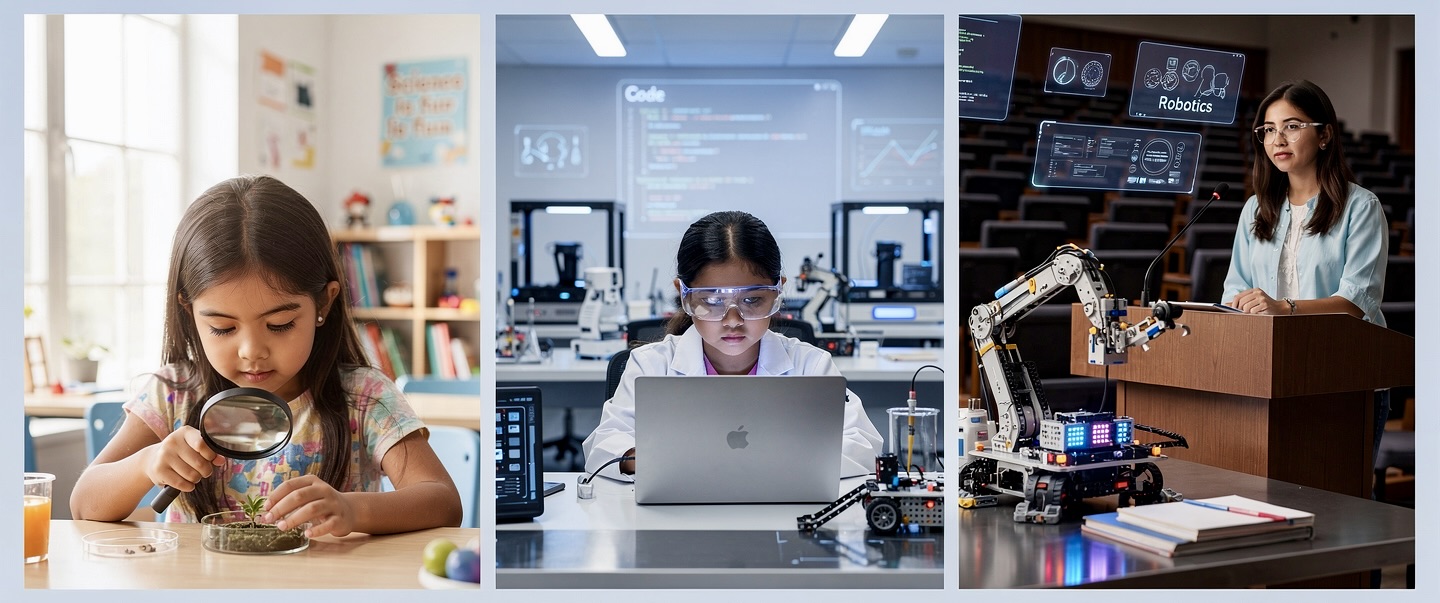
High School: The Spotlight
High school arrives like a spotlight.
Counselors suggest “balanced schedules.” Advanced physics is labeled “challenging.” Engineering clubs are “mostly boys, but you’re welcome to join.” She hears the unspoken translation: Are you sure?
Prom announcements echo through the halls. Conversations turn to dresses and dates, futures shaped by weddings and timelines that feel too narrow for the galaxies she sketches in her notebook.
Shifting Messages: Discovering Role Models
Then, something begins to change.
In a history unit, she discovers Marie Curie, who carried curiosity through radiation and resistance. She learns about Katherine Johnson, whose calculations helped launch humans beyond Earth. Unexpectedly, she finds out that Hollywood actress Hedy Lamarr was also an inventor, creating the foundation for GPS and WiFi. Then comes Ada Lovelace, who envisioned computers before they existed.
For the first time, the messages shift: Someone like you has done this before.
Defining Her Future
College applications ask who she wants to become.
The question feels enormous yet familiar.
She writes about numbers, patterns, and the quiet thrill of solving the impossible. She writes about the noise she learned to navigate.
Not all barriers are visible:
- Some are made of expectations.
- Some are made of doubt.
- Some are shaped by the subtle gravity of tradition, pulling her toward paths she never chose.
And then— she chooses.
She chooses the lecture hall where she is one of a few women. She embraces late nights, failed experiments, and breakthroughs that feel like sunrise. She chooses curiosity over permission.
A Stronger Self
The world does not suddenly become easier.
But she becomes stronger.
Every solved theorem cracks the walls that once surrounded her. Every question she asks opens a doorway for someone else.
Years later, she stands before a classroom, laboratory, or research team and realizes something extraordinary:
The messages are still out there.
But so is she.
Now, a young girl somewhere is looking at her the way she once searched history’s pages—hoping to find proof that it is possible.
She meets that hope with certainty.
Yes, the world will try to define you.
Yes, the noise will sometimes be overwhelming.
But curiosity is louder.
And the walls, no matter how carefully built, were never meant to hold you.
Honoring Black History Month: SHE IS BLACK
Leadership in the Garden of the Soul: Lessons from Magdalene Walker McCormick (Grandma)
Ready to talk it through?
Book a free consultation (30 min) →