Wisdom Wednesday
Wisdom Wednesday - Go Be Pretty: Hedy Lamarr and the Invention They Refused to Credit
Part 5 of 5 · Revolutionary Leadership Series
July 29, 2026

Part 5 of the Revolutionary Leadership Series - The history books gave you the category. This series gave back the strategy underneath it.
You already think you know Hedy Lamarr.
Golden Age Hollywood. Raven hair. The woman MGM called "the most beautiful in the world." A glamorous actress from another era, photographed exquisitely, and, as far as every institution around her was concerned, not much else.
That was never an accident. It was a directive.
She co-invented the foundational technology that now underpins WiFi, Bluetooth, and GPS. During World War II. While under contract to MGM. The U.S. Navy received the patent, shelved it, and told her she could do more for the war effort by selling kisses at bond rallies.
Go be pretty. Leave the real work to the men.
She never saw a cent from a technology now embedded in billions of devices worldwide.
She was recognized by the Electronic Frontier Foundation in 1997. She was 82 years old.
This is not a story about a beautiful actress who happened to be clever. It is a story about a woman of extraordinary strategic intelligence that every institution around her worked, actively and deliberately, to ignore. Not because they couldn't see it. Because they didn't want to. A woman had no business being the most capable person in a room full of military engineers.
The category was already decided. The rest was inconvenient.
It took half a century for the world to credit what she built. The leadership lesson inside that silence is one of the most urgent in this entire series.

Hedy Lamarr- surrounded by inventions that are now common place, the she never got credit for when it saved the world from fascism
The Education Nobody Planned For Her
Hedwig Eva Kiesler was born in Vienna in 1914 into a Jewish family of some means. Her father, a bank director with an insatiable curiosity about how things worked, took her on long walks through the city explaining the mechanics of everything they passed: printing presses, streetcars, manufacturing equipment. She was dismantling her music box to understand its inner workings by the age of five.
At eighteen, she was one of the most striking young women in European cinema. Friedrich Mandl, one of the three wealthiest men in Austria and an arms manufacturer with close ties to Mussolini and Hitler, became obsessed with her. She married him. It was, by every account, a catastrophic decision she recognized almost immediately.
Mandl was controlling to the point of imprisonment. He banned her from acting. He monitored her movements. He kept her at his side for business meetings and lavish dinner parties attended by Mussolini, Nazi officials, and the military scientists who built weapons for the fascist war machine.
He wanted a trophy. What he had, without understanding it, was a student.
Lamarr sat at those dinner tables for four years, largely invisible to the men who assumed she was decorative, absorbing everything. The mechanics of torpedo guidance systems. The vulnerabilities of radio-controlled weapons. The specific technical problem that military engineers across Europe were wrestling with: how to prevent an enemy from jamming the radio signal that guided a torpedo to its target.
She filed it away. She performed the role of the beautiful, disinterested wife. She was taking notes. In 1937 she escaped, leaving a dinner party wearing her jewelry sewn into her clothing, making her way to Paris, then London, where she maneuvered herself onto the same ocean liner as Louis B. Mayer and negotiated a Hollywood contract on the voyage.
She arrived in New York with a new name, a seven-year MGM deal, and a technical problem she couldn't stop thinking about.
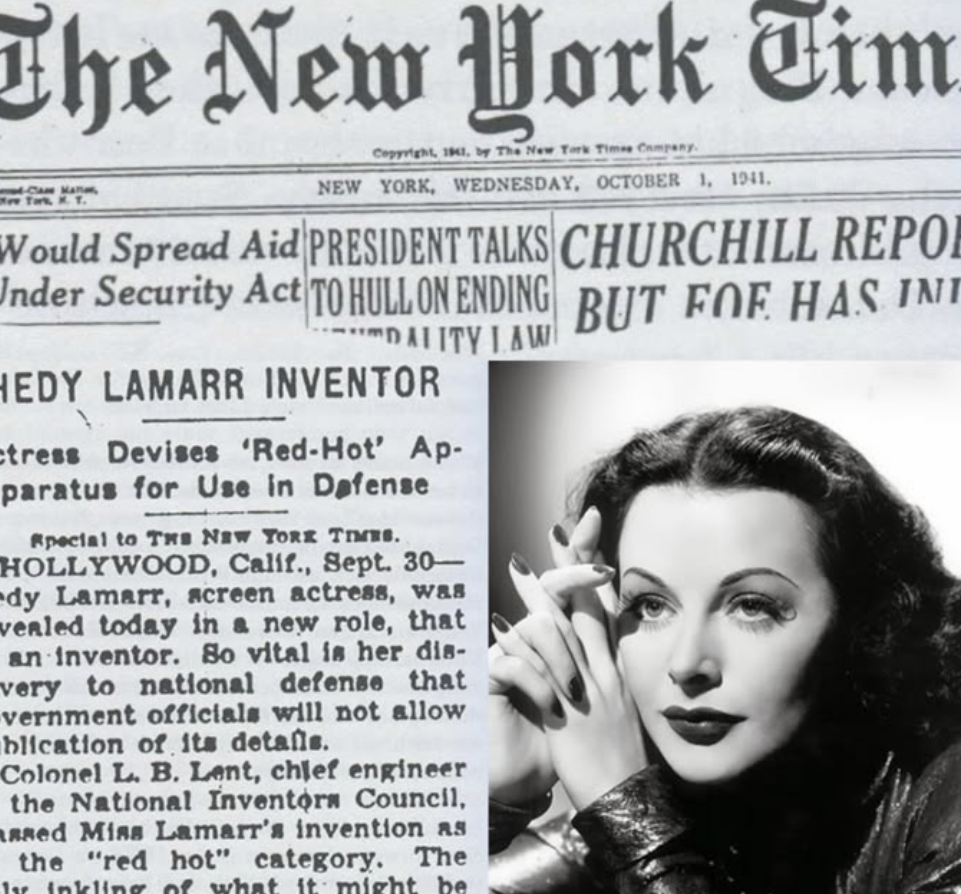
New York Times- October 1, 1941 - Cover Story - Hedy Lamarr Inventor
The Invention Nobody Expected
By 1940, Hedy Lamarr was one of Hollywood's biggest stars. She was also, in her trailer between takes, working on a weapons system.
Howard Hughes, who she dated briefly, gave her a small set of laboratory equipment to use on set. He encouraged her intellectual curiosity in a way almost nobody else in Hollywood did. She consulted with his engineers. She studied fish and birds to help him design faster planes. She was, by every account, far more interested in the work than in the celebrity.
The torpedo problem had never left her. Radio-guided torpedoes were being jammed by enemy forces.
They would detect the signal frequency and broadcast interference on the same channel, sending the weapon off course. The solution, as she saw it, was to make the signal impossible to track by having both the transmitter and the receiver jump between frequencies simultaneously: fast, random, synchronized. If both ends of the communication were hopping together, the signal couldn't be jammed because there was no fixed frequency to jam.
She developed this concept in collaboration with George Antheil, an avant-garde composer she knew socially, whose work with synchronized player pianos gave them the mechanical model they needed. The torpedoes and the player pianos operated on the same principle: synchronized, simultaneous movement across a range. They built the concept into a workable design and filed U.S. Patent No. 2,292,387 on June 10, 1941.
The Navy reviewed it. Decided it was too complex to implement. Shelved it.
And suggested that Lamarr, given her public profile, would be more useful selling war bonds.
She went and sold the war bonds. She raised $25 million in a single evening, the equivalent of roughly $450 million today. She did what was asked of her.
The patent expired in 1959, before the Navy declassified and began deploying frequency-hopping technology in the early 1960s. By the time the technology found its way into the communications infrastructure that would eventually become WiFi, Bluetooth, and GPS, the patent had long since lapsed.
Neither Lamarr nor Antheil received a dollar.

A Ziegfeld Follies Girl? Or a Genius?
What the Establishment Actually Did With Her
The pattern across Lamarr's life is worth naming plainly, because it is not subtle and it is not ancient history.
Every institution she encountered looked at her and saw the thing it expected to see.
Mandl saw a trophy wife and used her accordingly. He never once registered that the woman sitting silently at his dinner tables was cataloguing technical intelligence that she would later weaponize against the system he represented.
MGM saw a face and a figure and built a career around both, giving her roles that required her to be beautiful and little else, keeping her extraordinary mind entirely outside the frame of what they thought they were paying for.
The U.S. Navy saw a movie star with a patent and sent her to sell war bonds.
The patent system gave her a filing date and an expiration date and nothing in between. Each of these institutions made the same error: they assessed what was visible and missed what was actually there. They processed Hedy Lamarr through the category they had available: actress, beauty, celebrity. And filed the rest.
This is not just a historical injustice. It is a failure mode that operates in every organization at every level right now.
The person in the room who doesn't fit the expected profile. The idea that arrives from an unexpected source. The contribution that doesn't map to the existing org chart. The expertise that comes dressed in a way the institution wasn't looking for.
Every time an organization defaults to the visible category instead of looking at what is actually present, it is making the same mistake the Navy made in 1942.
The question for you: Who in your organization is sitting at the table, absorbing everything, waiting for someone to actually ask what they know?
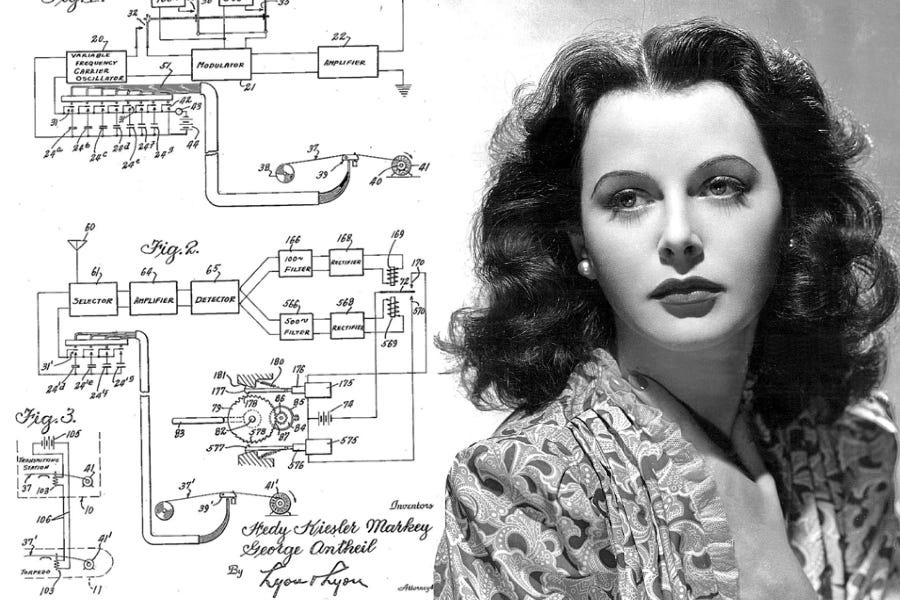
Hedy Lamarr- The Cross-Domain Thinker
The Cross-Domain Thinker as Competitive Advantage
There is a specific kind of intelligence that institutions consistently undervalue: the ability to move between domains and see connections that specialists cannot.
Lamarr's invention didn't come from military engineering. It came from the intersection of military intelligence she absorbed at her husband's dinner tables, applied physics she taught herself, and a musical concept about synchronized player pianos she developed with a composer. None of those domains, alone, produces frequency-hopping spread spectrum technology. The combination of all three does.
This is cross-domain thinking, and it is one of the rarest and most valuable capabilities in any organization. It requires a mind that hasn't been fully captured by any single field, that can hold frameworks from different disciplines simultaneously and find the structural similarity underneath surface-level difference.
Lamarr was able to see the torpedo problem clearly partly because she was not a military engineer. She hadn't spent twenty years inside the assumptions of that field. She came to it from the outside, with technical knowledge she had assembled herself from unconventional sources, and she saw a solution the specialists had missed.
The organizations that build this capability deliberately, that create conditions where people from different disciplines actually talk to each other, where the marketing person is in the room with the engineer, where the finance lead has a real conversation with the product team, are the ones that find the frequency-hopping solutions their competitors can't see.
The ones that keep their experts siloed by function, talking only to other experts in the same domain, are the ones that look back in twenty years and realize the solution was in the room the whole time. Sitting quietly at the table. Waiting to be asked.
The question for you: Where are you organizing for depth at the expense of the cross-domain connections that produce breakthrough thinking?

Lamarr at age 82
The Long Silence and What It Cost
Hedy Lamarr spent most of her adult life not talking about the invention.
Not because she was ashamed of it. Because nobody asked. The world she inhabited, Hollywood, the studio system, the celebrity press, had no interest in and no framework for an actress who had co-invented a military communications technology. The two things simply didn't fit together in the cultural imagination of the time.
She grew older. The technology her patent described became the backbone of the global communications infrastructure. The world she had helped build wirelessly went on without her name attached to it.
In 1997, the Electronic Frontier Foundation gave her their Pioneer Award. She was 82. She accepted by phone, too frail to attend, and reportedly said:
"It's about time."
Three words. Fifty-five years of waiting.
She was inducted into the National Inventors Hall of Fame in 2014. She had been dead for fourteen years.
The recognition came. It always does, eventually, for the people whose ideas were real enough to outlast the institutions that ignored them. The tragedy is not that it was late. The tragedy is all the time between the invention and the acknowledgment: the decades during which the idea was in the world, doing its work, while the person who conceived it was invisible inside the category the world had decided she belonged to.

The Revolutionary Leadership Series- Tubman, Joan, Scott, Sondheim, and Lamarr
The Series Closes Where It Started
Five weeks ago, this series opened with Harriet Tubman running escape routes on Saturday nights while the newspapers slept. A forensic strategist who had been handed to history as a saint.
Since then: Joan of Arc briefed a failing king with military precision and held her ground for fourteen months in a trial designed to break her. MacKenzie Scott moved $26 billion by removing herself from the center of her own power. Stephen Sondheim built things the market didn't have the language for and waited twenty years for the verdict to catch up.
And Hedy Lamarr sat at a dinner table in Vienna, surrounded by men who saw a trophy, and quietly learned enough about weapons systems to invent the technology that now connects the world.
The through-line has been the same in every piece: the history books gave us the category. The real story is what was happening underneath it. The strategic intelligence, the long game, the conviction held in the absence of recognition, the idea that was real before the institution was ready to receive it.
We are living through a moment that is calling for exactly this kind of leadership. Not the performed version. Not the safe version. The kind that knows what it's building before the market has the language for it, and builds it anyway, quietly, precisely, and with the patience to let the world catch up.
At Visionary Consulting, that's the work we do. Not helping leaders look the part. Helping them build something real enough to outlast the moment it arrives in.
The revolution doesn't wait for the institution to be ready. Are you?
This concludes the Revolutionary Leadership Series. Thank you for following along. The work continues: in the room, at the table, and in every organization brave enough to ask what it's actually building and why.
August is something different. The Reckoning is a four-week series built around the questions that this moment is actually asking, the ones most organizations are managing around because honest engagement with them requires the same quality of conviction this series has been excavating all month.
Four questions. Four weeks. No safe answers.
The disruption doesn't wait for your permission. Neither does August.
Wisdom Wednesday: The Manager You Automated Was Never the Manager You Needed
Wisdom Wednesday: The Quiet Coup: MacKenzie Scott and the Destruction of the Fortress
The Revolutionary Leadership Series
Five leaders, five eras, one question: what does revolutionary leadership actually cost?
- 01Wisdom Wednesday: The Underground CEO - Harriet Tubman's Strategy in the Shadows
- 02Wisdom Wednesday: The Cost of Conviction: Joan of Arc - When the Vision is a Fire
- 03Wisdom Wednesday: The Quiet Coup: MacKenzie Scott and the Destruction of the Fortress
- 04Wisdom Wednesday: The Art of the Long Game: What Stephen Sondheim Knew About Building What the Market Doesn't Know It Wants Yet
- 05Wisdom Wednesday - Go Be Pretty: Hedy Lamarr and the Invention They Refused to Credit (you are here)
Ready to talk it through?
Book a free consultation (30 min) →