Wisdom Wednesday
Wisdom Wednesday: The Art of the Long Game: What Stephen Sondheim Knew About Building What the Market Doesn't Know It Wants Yet
Part 4 of 5 · Revolutionary Leadership Series
July 22, 2026

Part 4 of the Revolutionary Leadership Series
You already think you know Stephen Sondheim.
The greatest composer-lyricist in Broadway history. The genius behind “ West Side Story”,
“Sweeney Todd”, “Into the Woods”. The man Lin-Manuel Miranda credits as the reason
“Hamilton” exists. A legend, yes. A giant, certainly.
What the history books don't tell you, what the obituaries got close to but didn't quite name, is the specific strategic intelligence underneath the artistry. The deliberate, patient, decades-long architecture of a leader who understood something that most executives never figure out: that the market cannot tell you what it wants until someone builds it first. And that building it first will cost you, commercially, critically, personally, until the moment it doesn't.
Sondheim paid that cost. Repeatedly. On purpose.
That's not a story about art. It's a masterclass in the long game.
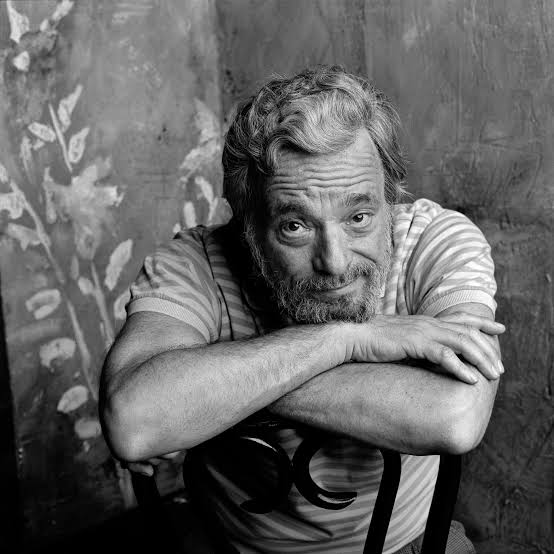
Stephen Sondheim
The Map He Was Given, and the One He Drew Instead
In 1957, Stephen Sondheim was 27 years old and had just been offered a position that would have defined most careers for a lifetime: lyricist for " West Side Story", working alongside Leonard Bernstein, playwright Arthur Laurents, and choreographer Jerome Robbins. Four titans. One of the most consequential musicals in American history.
He almost turned it down.
Not because the work wasn't extraordinary, he knew it was. But because he was afraid of being categorized. He had been mentored for a decade by Oscar Hammerstein II, who had told him with great specificity: write music and lyrics, or you'll spend your career being the person who does half the job. Taking West Side Story as lyricist only felt like a step toward a box he didn't want to be in.
Hammerstein told him to take it anyway, that working with those three people would teach him more than anything else available to him at 27, and that the doors it opened would matter more than the categorization he feared.
He was right. But the lesson Sondheim actually absorbed went deeper than Hammerstein intended: that the fear of being misread by the market is not a reason to make a different choice. It's a reason to be more precise about what you're building and why.
He spent the next fifty years being more precise.
The Decade the Establishment Called Him Uncommercial
“Company” opened in 1970. It had no conventional plot, just a series of vignettes circling an ambivalent bachelor named Bobby and five married couples who collectively examined whether modern urban relationships were even possible. No love story. No resolution. No one to root for in the traditional sense.
The establishment didn't know what to do with it. Audiences came, but divided. Critics circled it warily. The industry consensus was that Sondheim was brilliant but difficult, the kind of artist you admired from a distance while wondering when he'd write something you could actually sell.
He responded with " Follies" in 1971. Then " A Little Night Music" in 1973. Then "Pacific Overtures" in 1976 — a musical about the westernization of Japan told entirely from a Japanese perspective, using Kabuki theatrical conventions. Then " Sweeney Todd" in 1979, a horror opera about a murderous barber whose victims were baked into meat pies, set against the dehumanizing machinery of the Industrial Revolution.
When " Sweeney Todd" previewed, audiences stampeded for the exits. Critics called it "repellent," "sick," and "loathsome." It won eight Tony Awards, including Best Musical, sweeping every major category. It commercially underperformed. Sondheim himself later called it "a resounding commercial failure" on Broadway and in London's West End.
Today it is performed in opera houses around the world. Tim Burton's 2007 film adaptation was a critical and commercial hit. It is considered one of the greatest musicals ever written.
The distance between the initial reception and the eventual verdict: about twenty years.
Sondheim knew that distance was coming. He built anyway.
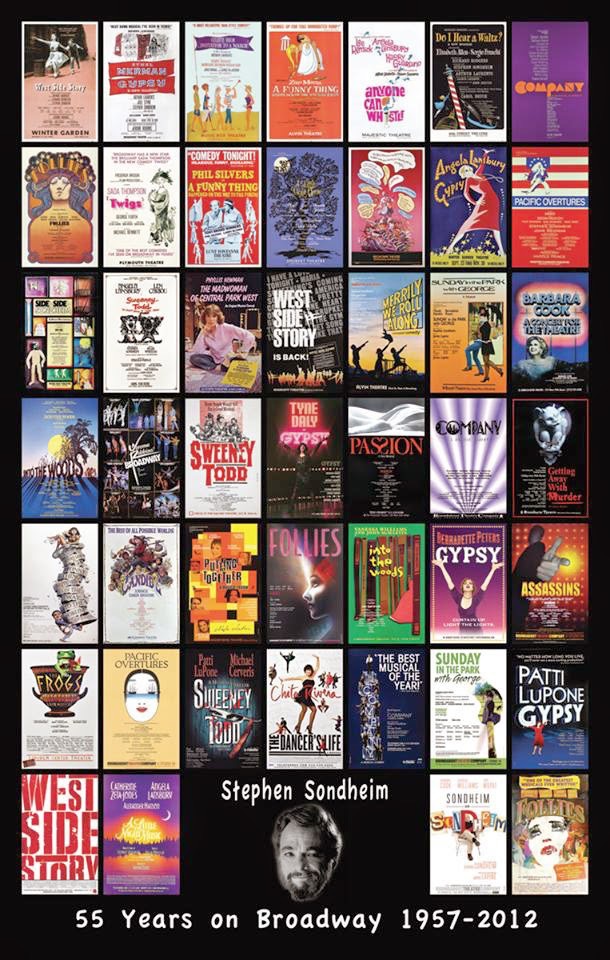
Sondheim's Playbills over his 55 Year Broadway Career
What He Understood About the Market That the Market Didn't
Here is the insight at the center of Sondheim's strategic intelligence, and it applies to every organization trying to build something genuinely new in a market that doesn't yet have the language for it:
The first reception of anything that moves the category forward is almost always wrong.
Not because the audience is foolish. Because the audience is calibrated to what already exists.
They evaluate the new thing against the existing map, and if the new thing doesn't fit the map, they call it a failure. The map is the reference point, not the work.
Sondheim understood this with unusual clarity. He wasn't building shows for the market that existed. He was building shows for the market that would exist once audiences had spent twenty years absorbing what he was doing. He was, in the most literal sense, playing a game with a time horizon that most of his contemporaries couldn't see.
“Merrily We Roll Along”, his 1981 collaboration that ran for just 16 performances before closing, devastating both Sondheim and his longtime director Harold Prince and ending their working relationship, is the sharpest example. The show told its story in reverse chronological order, beginning at the characters' most cynical and ending at their most idealistic. Audiences found it confusing and cold. It was considered one of Broadway's most spectacular failures. It has since been called one of his greatest works. A film adaptation directed by Richard Linklater — shot over twenty years to allow the cast to age in real time, is in production. Its time came. Just not on the schedule the market had available.
Lin-Manuel Miranda put it plainly: "The initial reception is only the rough draft of legacy. Salieri was the big court composer of the day, but it's only Mozart we talk about."
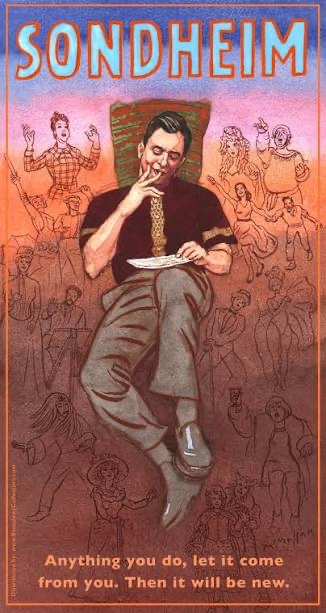
Sondheim surrounded by drawings of his characters. The last line of "Sunday in the Park with George" is at the bottom. It states "Anything you do, let it come from you. Then it will be new." It is missing the very last line. "Give us more to see."
The Mentor Who Built the Next Generation in Secret
Here is what almost never gets included in the Sondheim story: the infrastructure he spent fifty years building behind the scenes, person by person, letter by letter.
After Oscar Hammerstein II mentored him through his formative years, giving him the framework, the standards, and the instruction to write like himself rather than like his mentor, Sondheim made a deliberate decision to pass that forward. Not loudly. Not institutionally.
Quietly, through direct engagement with the next generation of composers who wrote to him. He answered every letter. Every email. He would quietly appear at the back of workshops for new musicals, then follow up with the composer directly. He founded Young Playwrights Inc. to give young writers access to the form. He became Oxford University's first Visiting Professor of Drama and Musical Theatre.
Jonathan Larson, who wrote " Rent", which ran for twelve years on Broadway, was one of his mentees. When Larson was struggling with an early musical, Sondheim didn't just offer encouragement. He wrote and recorded a version of a scene himself to demonstrate the note he was trying to give. Larson died the night before “Rent” opened. Sondheim wrote him a letter of recommendation that Lin-Manuel Miranda later shared publicly, a document of the kind of specific, committed investment in another person's work that most leaders never make.
Miranda himself credits Sondheim with the foundational architecture of his creative approach. "The greatest legacy Oscar gave him," Miranda said, "was telling him: don't write like me. Write like you. If you write like you, you're going to be ahead of everybody else." Sondheim passed that instruction forward intact.
He built the next generation of the field while he was still building the field itself. That is not mentorship as a leadership accessory. That is succession planning as a core strategic commitment.
The question for you: Who are you writing letters to, and are you doing it before they're famous, or after?
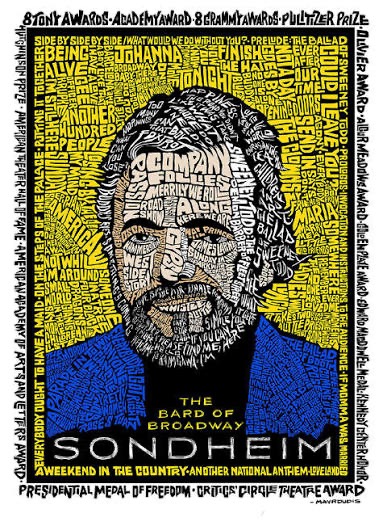
Artistic Drawing of Sondheim comprised of lyrics from his shows and professing him to be "The Bard of Broadway". Because, he was, indeed.
The Four Lessons the Long Game Actually Teaches
1. The market's initial verdict is data, not truth.
Every organization building something genuinely new will face a version of the “Sweeney Todd” problem: the audience evaluates the new thing against the map they have, and the new thing doesn't fit. That reception feels like failure. It is often actually evidence that you've moved ahead of the category. The question is whether you have the conviction and the runway to wait for the market to catch up.
2. Categorization is a cage you build yourself by fearing it.
Sondheim's near-refusal of “West Side Story” was a near-miss with his own fear of being misread. Hammerstein's advice, take the opportunity, the doors matter more than the label, saved him from a self-imposed limitation that would have cost him a decade. How many of your organization's decisions are driven by fear of how you'll be categorized rather than clarity about what you're actually building?
3. The investment in the next generation is a long game, not a gesture.
Sondheim didn't mentor people by showing up at a panel and offering general encouragement. He answered every letter. He recorded demonstrations. He founded institutions. He made room in a working life at the top of his field for the specific, time-consuming work of developing the people who would extend what he was doing. The legacy he left wasn't just the shows — it was the generation that learned to write from him.
4. Build for the work, not for the reception.
Sondheim said until the end of his life that he had never written a hit. By conventional measures, he was right, most of his shows underperformed commercially on their initial runs. Against every other measure, he was the standard against which the entire field was judged. He built for the work. The reception followed, on its own schedule, twenty years late and completely irreversible.
The question for you: What are you building that the market doesn't have the language for yet, and do you have the conviction to keep building it while it waits for the world to catch up?
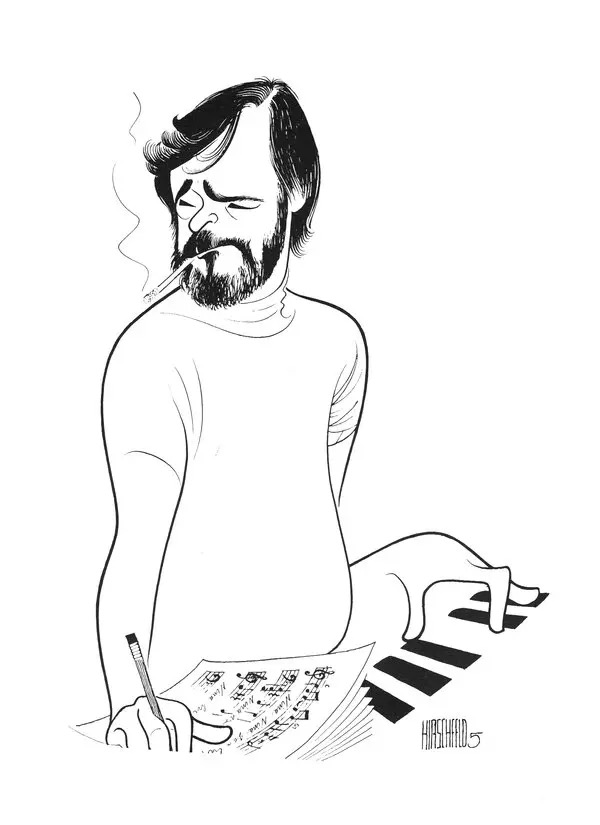
Al Hirschfeld's famous New York Times drawing of Sondheim
The Revolution Nobody Announced
Sondheim didn't hold press conferences about disrupting musical theatre. He didn't write manifestos about what the form needed to become. He just kept making work that was further ahead than anyone else's, developed the people around him with unusual generosity, and trusted that the time horizon would eventually vindicate the choices.
It did. It always did.
“Company” is now considered the work that modernized the American musical. “Sweeney Todd” plays in opera houses. “Into the Woods” has been made into a major film. “Hamilton”, the most successful musical in a generation — is, in Miranda's own telling, built on the foundation Sondheim laid.
At Visionary Consulting, this is one of the most consistent gaps we see in executive leadership: the inability to hold conviction about a direction when the initial market reception is ambivalent or hostile. The pressure to adjust, to soften, to make the work more legible to the current map is enormous, and it arrives exactly when the work is most important to protect.
The leaders who change their fields don't do it by reading the current map more carefully than everyone else. They do it by being more certain than everyone else that the current map is wrong. Sondheim never lost a passenger. He just played on a longer timeline than most people were willing to watch.
Are you building for the reception — or for the work?
This is Part 4 of the Revolutionary Leadership Series. Next Week: Go Be Pretty: Hedy Lamarr and the Invention They Refused to Credit
Wisdom Wednesday: The Quiet Coup: MacKenzie Scott and the Destruction of the Fortress
Wisdom Wednesday: The Underground CEO - Harriet Tubman's Strategy in the Shadows
The Revolutionary Leadership Series
Five leaders, five eras, one question: what does revolutionary leadership actually cost?
- 01Wisdom Wednesday: The Underground CEO - Harriet Tubman's Strategy in the Shadows
- 02Wisdom Wednesday: The Cost of Conviction: Joan of Arc - When the Vision is a Fire
- 03Wisdom Wednesday: The Quiet Coup: MacKenzie Scott and the Destruction of the Fortress
- 04Wisdom Wednesday: The Art of the Long Game: What Stephen Sondheim Knew About Building What the Market Doesn't Know It Wants Yet (you are here)
- 05Wisdom Wednesday - Go Be Pretty: Hedy Lamarr and the Invention They Refused to Credit
Ready to talk it through?
Book a free consultation (30 min) →