Wisdom Wednesday
Wisdom Wednesday: The Cost of Conviction: Joan of Arc - When the Vision is a Fire
Part 2 of 5 · Revolutionary Leadership Series
July 8, 2026

Part 2 of the Revolutionary Leadership Series

Joan of Arc in Battle
Here is what the history books tend to leave out about Joan of Arc: she wasn't operating on faith alone.
Yes, she heard voices. Yes, she believed she was called by God.
But what she did with that calling was not mystical - it was surgical.
She walked into the court of a failing king with a specific military assessment, a concrete plan of attack, and the kind of unshakeable clarity that made grown men with armies follow a teenager into a siege they'd been losing for months.
The voices may have been divine. The strategy was entirely her own.
In the 250th year of the American experiment: a year that is calling for exactly this kind of clarity - Joan of Arc is not a saint to be admired from a distance. She is a case study in what happens when conviction meets competence, and what it actually costs to hold both. Strip away the title, the budget, and the org chart.
What's left is either real or it isn't. That's the only leadership question that matters.

Mapping Out a Plan
The Audacity of the Specific
When Joan arrived at Chinon in February 1429, France had been losing the Hundred Years' War for nearly a century. The Dauphin Charles: not yet king, not yet crowned, not yet much of anything: was surrounded by advisors who had run out of ideas and were running low on territory. The English siege of Orléans was entering its fifth month. The professional soldiers had no answer.
Joan had one. And she didn't speak in generalities.
She told Charles precisely what she intended to do: relieve the siege at Orléans, escort him to Reims for his coronation, and begin dismantling English occupation from the inside out. Not a vision statement. A sequence of specific, executable objectives, delivered by someone with zero institutional authority and complete operational confidence.
This is what separates conviction from enthusiasm. Enthusiasm says something must change. Conviction says here is what changes, here is how, here is when. Joan didn't inspire the Dauphin: she briefed him. The inspiration was a byproduct of the specificity.
In modern executive coaching, we often see the slow bleed of clarity — vision that starts sharp and arrives at the team as noise. Leaders offer vague "North Stars" that provide no actual guidance for the team on the ground. Joan didn't offer a North Star; she offered a map. She entered Orléans on April 29th. The siege broke on May 8th. She had been in
the field for nine days.
The question for you: Conviction without coordinates is just noise. Are you giving your people a map or a mood?
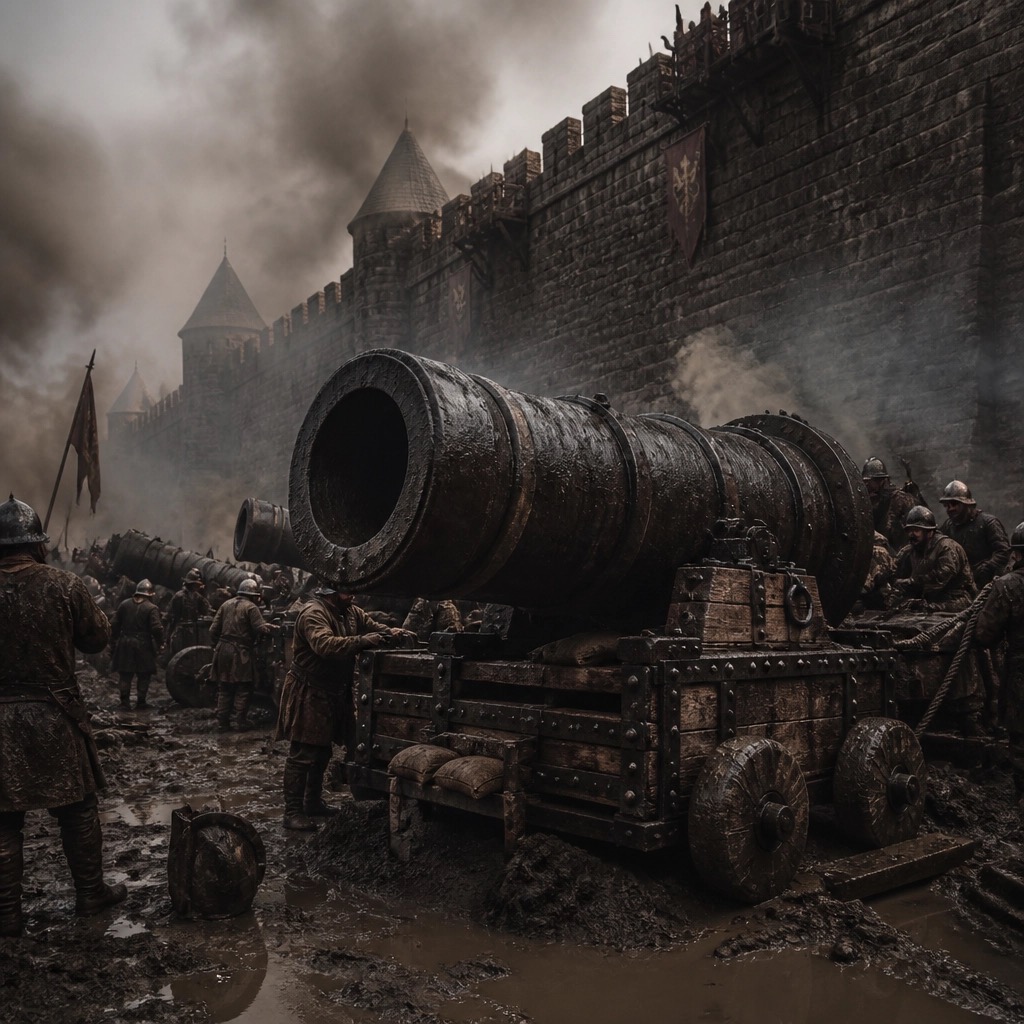
A Cannon in Battle
What She Did With the Cannons
Joan had no formal military training. What she had was the ability to look at a problem that experts had been failing at for months and ask a different question.
The French commanders at Orléans had been playing a grinding defensive game - holding positions, avoiding direct engagement, managing a slow bleed. Joan looked at the same battlefield and identified something they had stopped seeing - the English fortifications had seams. Points where the discipline was thin, where the supply lines were exposed, where an aggressive move would create chaos the English weren't positioned to absorb.
She didn't just place the cannons. She changed the frame. Instead of asking how do we survive this siege, she asked where is this siege brittle: and then she hit those points with speed the English hadn't encountered in years.
This is audacity in action. It is the disruption that occurs when a leader refuses to accept the default settings of their industry. She was wounded on May 7th: an arrow through the shoulder, above the breastplate. She pulled it out herself, returned to the field, and the fortress fell before nightfall.
This is not a metaphor. This is what it actually looks like when someone refuses to let the pain set the pace.
The question for you: Are you studying your biggest challenge from inside it, or have you been inside it so long you've stopped seeing the seams?

Joan on Trial
The Trial: When the Cage Becomes the Podium
Leadership isn't tested when the banners are flying. It's tested when everything has been taken away and the only thing left is what you actually believe.
Joan was captured in May 1430. Her trial began in January 1431. What followed was fourteen months of interrogation by some of the most highly trained legal and theological minds in Europe: men with every institutional advantage, questioning her in French and recording it in Latin, deploying complex theological paradoxes designed to make her
contradict herself or recant her claims.
She was nineteen years old and had no legal counsel.
The transcripts of her trial are one of the most remarkable documents in Western history: not because of what her accusers asked, but because of how she answered. When they tried to trap her with the question of whether she knew she was in God's grace (a theological catch-22: claiming to know was heresy, denying it was also heresy), she replied: If I am not, may God put me there; and if I am, may God keep me there.
But she didn’t stop there. She added that she would be the saddest soul alive if she knew she were not in God’s grace — and then turned the question back on her judges: if she were in a state of sin, would the Voice still come to her? She didn’t just escape the trap. She used it to reassert the very thing they were trying to take from her.
This was a forensic dismantling of her opposition. She did this repeatedly, for months: not from legal training she didn't have, but from a quality that no institutional authority can manufacture: she knew what she believed, and she knew it precisely enough to defend it under pressure designed to break her.
Most leaders have never been tested anywhere close to that standard. But the architecture of the test is the same. The critics, the cautious board members, the colleagues who smile in the room and undermine outside it - they are looking for the same thing Joan's judges were looking for: the moment your conviction turns out to be negotiable.
The question for you: If someone put your leadership convictions on trial, how long would they hold?
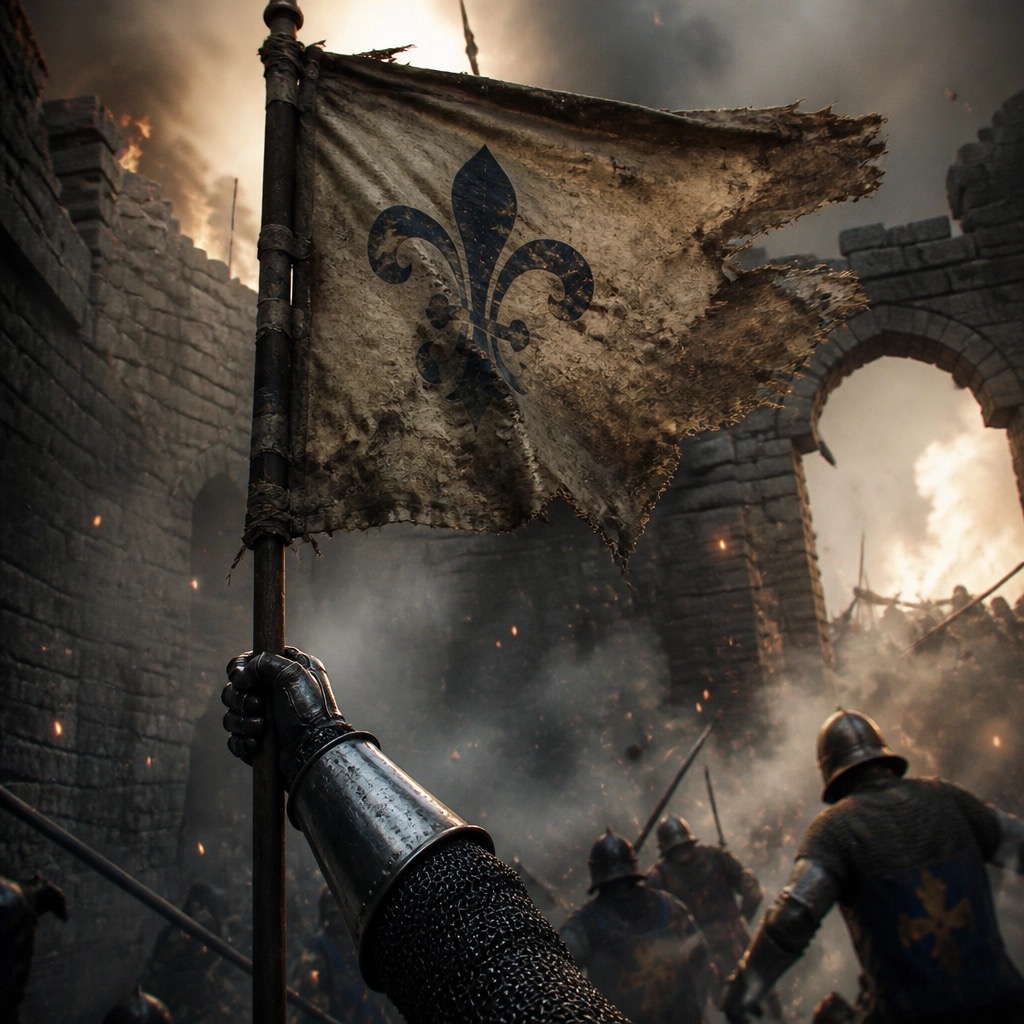
The French Flag in the Trenches of Battle
The Gap Between the Banner and the Trench
Joan carried her standard into the breach at Orléans. Not to the edge of it: into it. She was not a general who directed from safety; she was a commander who was willing to be the most visible person in the most dangerous place, on the theory that her people would go anywhere she was willing to go first.
She was wounded twice in the field. Both times she returned.
This matters beyond the drama of it. There is a particular kind of organizational failure that happens when leadership and execution live in different worlds: when the people making the decisions have no real proximity to the consequences of those decisions. The gap between the strategic tower and the operational trench is where trust goes to die. People can feel it. They calibrate their own commitment accordingly. Joan closed that gap entirely. Her army's transformation at Orléans - from demoralized and stalled to relentless- wasn't primarily about tactics. It was about the visible, physical proof that the person asking them to risk everything was risking the same thing.
What is one of the most consistent patterns we see in change management consulting? Leaders who are genuinely committed to their vision but have inadvertently put distance between themselves and the work their people are doing. The fix is rarely structural. It's almost always about presence. It is the unearthing of the purpose driven leader within.
The question for you: Where is the gap between what you're asking of your people and what you're willing to do yourself?

Paying the Cost of Conviction
What the Fire Left Behind
They burned Joan of Arc on May 30, 1431. She was nineteen.
Twenty-five years later, a retrial ordered by the Pope found her innocent on every charge. Within a generation, the English had lost virtually all of France. Five centuries later, she was canonized.
History doesn't always vindicate conviction in time for it to matter to the person who held it. That's the actual cost: not the discomfort, not the career risk, not the difficult conversation. The actual cost is the possibility that you'll pay the full price and not be there to see the outcome.Joan knew this. The trial transcripts make clear she understood what was coming. She had even recanted once, under threat of the fire — and then, within days, took it back, reaffirming the voices knowing exactly what it would cost. She held her position anyway: not because she was reckless, but because she had already decided that her conviction was worth more than her survival. There was a resonance in her death that changed the course of history more effectively than a thousand compromises ever could.
Most of us will never face a test that severe. But the leaders who move organizations, who shift industries, who change what's possible for the people around them: they share something with Joan that has nothing to do with martyrdom. They have decided, at some fundamental level, what they are not willing to trade away. And that decision holds when the pressure is on.
In every leadership development engagement we build, it's not about the performance of conviction. It is the real thing: specific, pressure-tested, and clear enough to defend in a room that doesn't want to hear it.
The revolution doesn't need your enthusiasm. It needs your precision.
Are you ready to pay the cost of conviction?
This is Part 2 of the Revolutionary Leadership Series. Next: MacKenzie Scott : The Quiet Coup, Reimagining Wealth as a Weapon.
Wisdom Wednesday: The Underground CEO - Harriet Tubman's Strategy in the Shadows
The Revolutionary Leadership Series
Five leaders, five eras, one question: what does revolutionary leadership actually cost?
- 01Wisdom Wednesday: The Underground CEO - Harriet Tubman's Strategy in the Shadows
- 02Wisdom Wednesday: The Cost of Conviction: Joan of Arc - When the Vision is a Fire (you are here)
- 03Wisdom Wednesday: The Quiet Coup: MacKenzie Scott and the Destruction of the Fortress
- 04Wisdom Wednesday: The Art of the Long Game: What Stephen Sondheim Knew About Building What the Market Doesn't Know It Wants Yet
- 05Wisdom Wednesday - Go Be Pretty: Hedy Lamarr and the Invention They Refused to Credit
Ready to talk it through?
Book a free consultation (30 min) →